FAQ
CIE Teacher Pathway Overview
The CIE Teacher Pathway is a clear, step-by-step route from practical teaching skills to professional qualification, and then (optionally) to a bachelor’s degree:
Step 1: TESOL-40 — learn 40 brain-based teaching methods and strategies you can use immediately.
Step 2: TESOL-120 — reach the 120-hour professional benchmark, with structured development including lesson planning and evaluated teaching practice with feedback.
Step 3: BA in Education — progress into degree-level study awarded through our partner Université de la Renaissance d’Haïti (URH). CIE TESOL graduates may receive 12 credits toward the degree.
Most students start with TESOL-40 if they are new to teaching or want a strong methods foundation.
Start with TESOL-120 only if you have already completed a 40-hour CIE TESOL course (online or in-person), since it is a prerequisite.
If your goal is a degree route, you can plan toward the BA in Education (Step 3). Many students begin at Step 1, then advance as they build experience and credentials.
To take TESOL-120, you must have completed a 40-hour CIE TESOL course first (Step 1).
The BA in Education is designed to be compatible with the pathway—CIE TESOL courses contribute 12 credits toward the degree—but the degree itself is a broader program with multiple components (coursework plus relevant work experience).
TESOL-40: approximately 40 hours of training content.
TESOL-120: approximately 80 hours, including applied work such as lesson planning and teaching practice.
BA in Education: structured as a 130-credit degree program and includes 2,000 hours of relevant work or volunteer experience (with flexibility depending on your background).
Yes. The TESOL courses are online and designed for flexible progress. TESOL purchases include 6 months of access, with optional continued access via a low-cost monthly subscription of $2.99.
For the BA in Education, the program includes online study that can be completed “at your own time and pace,” alongside the required experience components. BA access is provided for 2 years; after that, continued access is available for $9.99/month.
TESOL-40
TESOL-40 is for anyone who wants a strong, practical start in teaching English—especially those who want to build confidence quickly through brain-based teaching methods they can use immediately. It is also a solid “reset” for tutors or teachers who want fresh ideas and more classroom energy.
You will learn 40 brain-based language-teaching methods and strategies, taught through short, high-impact video lessons with clear explanations and demonstrations. The course focuses on methods that make lessons more engaging, memorable, and effective—and that keep learners actively involved through purposeful interaction.
TESOL-40 focuses primarily on teaching methods. If you want the step that emphasizes professional development through lesson planning and evaluated teaching practice with feedback, that is the role of TESOL-120 (Step 2).
Yes. TESOL-40 is designed as Step 1 of the pathway and is intended to be the most practical place to start. It is method-driven and aims to help new teachers feel confident using proven techniques right away.
You are eligible if you have:
- Completed high school or equivalent (including home schooling), and
- A strong command of English: able to speak, read, and write fluently.
Yes. Non-native English speakers are welcome, provided you can speak, read, and write English fluently. “Fluent” does not mean perfect or native-standard—strong functional fluency is the goal.
Your purchase includes 6 months of access to the online content. Continued access beyond that is available on a monthly basis for $2.99.
After you complete the program, your certificate is issued by email (digital/PDF). Printed hardcopy certificates are available by request for an additional fee of $20.
Yes. CIE offers a discounted Graduate Refresher option (currently $89) for past graduates, which provides 6 months’ access to the TESOL course content; after that, continued access is available via a monthly subscription (currently $2.99/month).
TESOL-120
TESOL-120 is for TESOL-40 graduates who want to reach the 120-hour professional benchmark and develop the practical skills employers value—through lesson planning, teaching technique, and evaluated teaching practice with instructor feedback.
To enroll, you must have completed a 40-hour CIE TESOL course—either CIE’s one-week in-person program or the online TESOL-40.
TESOL-40 focuses on learning core teaching methods and strategies.
TESOL-120 builds on TESOL-40 and emphasizes application, planning, and guided practice, including structured lesson planning and evaluated teaching practice with feedback.
You will complete lesson planning assignments and structured teaching practice tasks, including submitting 5 lesson plans and 2 recorded teaching demonstrations for individualized instructor feedback.
Yes. You need the ability to record and upload short teaching practice videos for assessment.
You will need reliable internet access, a current web browser, and the ability to record and upload short teaching practice videos.
TESOL-120 leads to a 120-hour TESOL certificate, widely recognized as the baseline professional benchmark. The 120 hours are composed of TESOL-40 (40 hours of instruction) and TESOL-120 (80 additional hours of instruction).
A 120-hour TESOL certificate commonly meets stated requirements for many schools, is often expected by online teaching platforms, and can be required for roles linked to work visas.
Upon completion, graduates receive their certification by email. Hardcopy certificates are available by request for $20.
After TESOL-120, graduates may apply to continue into the BA in Education (Step 3). The TESOL-40 and TESOL-120 courses count as 12 credits toward the bachelor’s degree through CIE’s partner university.
BA in Education
The BA in Education is ideal for learners who are passionate about teaching, learning, and helping others grow. It suits both CIE TESOL graduates and experienced educators/tutors/school assistants (including those with professional or volunteer teaching experience) who want a recognized academic qualification in education.
You can enroll if you have:
1: Completed high school (or the equivalent in your country; homeschooling accepted), and
2: A good command of spoken and written English.
Most applicants are at least 18, but exceptional younger candidates may be accepted if they completed high school early.
Yes. Education majors are required to complete the CIE TESOL-40 course (online or in-person equivalent) and the TESOL-120 course.
Yes. Graduates of the CIE TESOL courses automatically earn 12 credits toward the BA in Education or any other of our degree offerings.
Most students can earn up to 79 credits toward the BA (when experience and learning meet degree-level expectations), commonly from:
- Prior learning: up to 21 credits
- Second language(s): up to 18 credits (maximum typically awarded for intermediate level or higher)
- Work experience: up to 40 credits (based on 2,000 hours of documented experience)
Credits are assessed flexibly and can be adjusted based on your strengths (e.g., more language credit if you have less work experience, and vice versa).
Because this is a Bachelor of Arts, a wide range of professional or volunteer experience can be credited, including:
- Teaching or tutoring (any subject)
- Community or volunteer service
- Work in education, language, or cultural organizations
- Roles involving communication, training, mentoring, or public speaking
- Administrative, creative, or leadership positions
The program is structured as the equivalent of a 4-year U.S. BA, but completion time varies depending on how much work experience (2,000 hours) and second-language skill you already have. Many students complete the online coursework portion in about one year, then finalize remaining requirements as needed.
Graduation is through Université de la Renaissance d’Haïti (URH), which awards the BA upon completion of requirements.
Recognition varies by country, employer, and sector, and can change over time—so acceptance is not guaranteed in every situation. CIE encourages students to contact the team if they have a specific country or employer requirement in mind.
Some students pursue credential/equivalency evaluations (e.g., in the U.S., Canada, or parts of Europe), but results vary by evaluating agency and are never guaranteed.
Your degree is issued after you have paid in full, submitted the necessary documentation, and completed all assignments. After that point, you can typically expect the degree within 60-90 days, allowing time for the partner university to evaluate your work and process graduation.
This degree is often a strong fit for roles where employers primarily need you to “check the box” for holding a bachelor’s degree (general employment, professional development, online teaching, private-sector teaching, freelance work, internal promotions).
However, CIE does not recommend the program for those targeting public school or university English-teaching roles, which typically require degrees from internationally recognized universities in native English-speaking countries. If you need the degree for a specific regulated purpose (such as a visa pathway or government role), contact CIE first so you can discuss realistic expectations for your destination and sector.
Certificates, Verification, and Documentation
TESOL (Teaching English to Speakers of Other Languages) and TEFL (Teaching English as a Foreign Language) are used almost interchangeably worldwide. Both prepare you to teach English to non-native speakers.
CELTA is a specific TEFL qualification awarded by Cambridge University.
You (or an employer) can verify a TESOL certificate using CIE’s online verification form. Enter as much information as you have (name, email, student number, year/month awarded). If it matches CIE records, verification is shown immediately; if key details are missing, CIE will follow up by email.
Yes. The fee for a replacement PDF certificate (sent by email) is $20.
If you’d also like a printed copy, the fee is $40, which includes shipping. Please note that printed certificates typically take 4–6 weeks to arrive.
Please email us at info@cie.world stating your full name, mailing address, and which option you need (digital only or digital and printed). We will then send you a secure payment link and process your order.
Yes. CIE can issue language teaching certificates for other languages you are qualified to teach. The TESOL course is grounded in second language acquisition and methodology, and those principles can be applied beyond English.
To request an additional certificate, contact CIE during or after your course. The fee is $20 per language (PDF); a printed copy is an additional $20.
Perhaps, if you plan to teach overseas. The law in some countries requires that overseas documents, such as educational certificates, be authenticated.
Countries generally fall into two categories: those who are parties to the Hague Convention and those that are not. Countries that are party to the Hague Convention will require your certificate to have the Apostille. As CIE TESOL certificates are issued in the US, the best place for our graduates to obtain the Apostille is the US.
If you live in the US, the most cost-effective way to obtain the Apostille is to handle the process yourself. This involves two steps: (1) Notarization. Take your original certificate, a good quality copy, and your ID to a Notary Public. For a fee, they will confirm your identity and that you have made a true, valid copy of your certificate. (2) Apostille: Send the copy of your certificate with the attached notarization to the Office of the Secretary of State in your home state. For a fee, they will confirm that the Notary Public was valid at the time of notarization, affix the Apostille to the notarization and send it back to you.
If you live outside the US and need the Apostille, please email us for a quote (prices will vary depending on mailing costs to the country where you live).
Countries that are not party to the Hague Convention will require your document to undergo the more complex process of legalization. Usually, this is a three-step process: (1) Notarization; (2) Apostille; (3) Embassy/representative office legalization.
The CIE 120-Hour TESOL Certificate is designed to meet widely accepted international expectations for entry-level English language teaching. It includes graded coursework, lesson planning, and practical teaching components, making it suitable for employment with many private language schools, online teaching platforms, and independent education providers.
CIE graduates have taught in numerous countries worldwide, and we often hear from former students and hiring organisations about job opportunities and requests for qualified teachers. These opportunities are shared through the CIE Jobs Board, which highlights schools and online companies that have either hired CIE graduates or actively seek them.
That said, there is no single global standard for TESOL recognition. Each school, employer, and country sets its own requirements, and these may change over time.
- Fill out and submit the CIE TESOL Certificate confirmation form. If you have entered the information correctly you will be redirected to a unique URL with a verification message and your certificate information.
- Copy the URL.
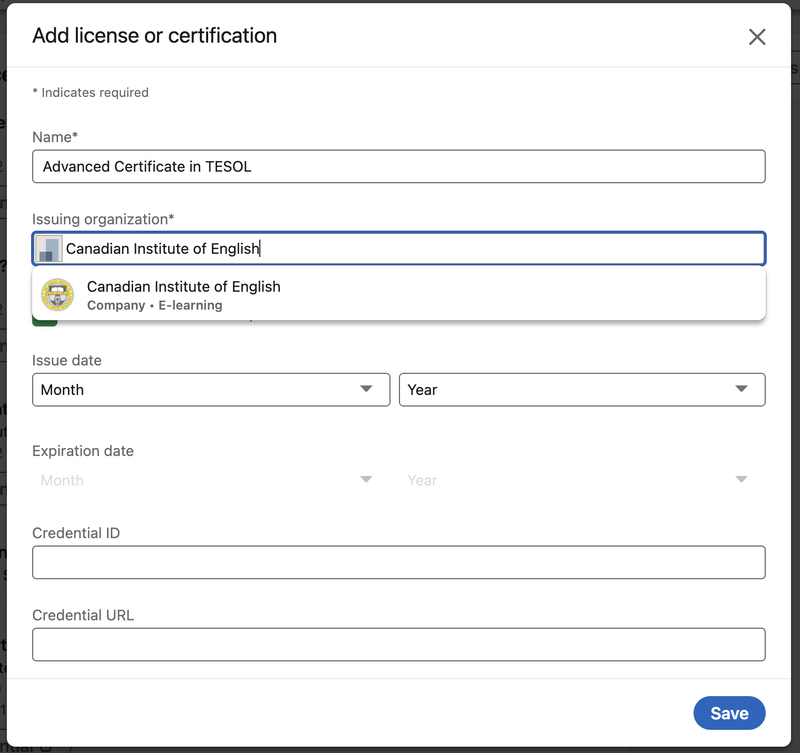
- Go to your profile in LinkedIn and create a new entry under Licenses & certifications. Enter these details:
- Name: Advanced Certificate in TESOL
- Issuing Organization: Canadian Institute of English
- Issue date: the month and year you received your certificate
- Credential ID: enter the student number from your certificate
- Credential URL: paste the unique URL from when you verified your CIE certificate - Check “This credential does not expire”
- Save.
Yes. CIE Learning and the Canadian/American Institute of English are accredited by the AAHEA, an independent U.S. organization. We received full accreditation in May 2023.
Why not regional accreditation?
Regional accreditation is costly and would increase course fees. We focus on accessible, high-quality education, and measure our success by the achievements of our students teaching in over 40 countries.
What does AAHEA accreditation mean?
It confirms that CIE meets high standards in curriculum, teaching, and student support.
How do you ensure quality?
Through a rigorous curriculum, experienced instructors, and continuous student feedback. Our students’ global success speaks for itself.
Is this recognized internationally?
Yes. While AAHEA is U.S.-based, our programs are respected worldwide. Student success remains the best measure of recognition.
Careers and Teaching Options
English is the global language of international business, education, travel, and online communication. As a result, there is sustained worldwide demand for qualified English teachers, particularly in non-English-speaking countries and in online learning environments.
In general terms, our experience suggests:
In many regions, the CIE TESOL certificate alone is often sufficient to secure teaching work, particularly (though not exclusively) for native English speakers, including:
-- Central and South America
- Southern Europe (including Spain, Portugal, and Italy)
- Eastern Europe
- Online and remote teaching markets
In some countries, a bachelor’s degree is required in addition to a TESOL certificate in order to qualify for a work visa. Common examples include:
- China
- Japan
- South Korea
- Taiwan
- Thailand
- Malaysia
In these cases, the TESOL certificate remains essential, but it must be paired with a degree. For this reason, many students choose to continue their studies with CIE by progressing into one of our bachelor’s degree pathways.
Teaching in English-speaking countries
The CIE TESOL certificate is primarily intended for teaching English as a foreign or second language, most commonly outside native-English-speaking countries. Formal teaching roles in countries such as the US, Canada, the UK, or Australia typically require a recognised degree in education and, in many cases, state or national teacher certification.
Without these qualifications, TESOL-qualified teachers in English-speaking countries usually work:
- As self-employed private tutors
- With adult learners or immigrant communities
- Online, teaching students based overseas
Important note
The information above is provided as a general guide, based on the collective experience of CIE graduates and faculty. Requirements vary by country, employer, and visa category, and they can change without notice. If you have a specific destination or career goal in mind, we strongly recommend researching current local requirements and contacting potential employers directly.
If you would like personalised advice on how the TESOL certificate fits into your longer-term academic or professional plans, CIE faculty are happy to help.
Yes – in recent years many of our students have found good success teaching English online. Although the hourly rate for teaching online may not be the highest out there, many prefer it because of the freedom and flexibility it offers. You can often plan your own schedule and don’t need to commute to work. It has allowed many to travel extensively or spend time in a foreign country and still support themselves. If you work for a company that provides online English lessons, they will usually assign you students according to your schedule.
Many past graduates have told us about companies they recommend. Other online companies or schools have reached out to us directly looking for more teachers. We have compiled a list of online schools and endeavor to keep it updated based on feedback from graduates.
Sometimes. In an increasing number of countries, a bachelor’s degree is required in addition to a TESOL certificate in order to qualify for a work visa. Common examples include:
- China
- Japan
- South Korea
- Taiwan
- Thailand
- Malaysia
CIE shares opportunities and hiring requests through the CIE Jobs Board, which highlights schools and online companies that have hired CIE graduates or have actively sought them.
CIE does not promise placement, since requirements vary widely by country, employer, and visa category. However, CIE can share guidance and resources based on graduate feedback (including curated lists of online schools/companies) and can advise you if you have a specific direction in mind.
Yes. Because teaching requirements can change without notice, CIE recommends researching current local requirements and contacting potential employers directly. If you share your target country and goals, CIE faculty can also provide personalized guidance on how your qualifications fit into your longer-term plan.
Support and Contact
Please email us at info@cie.world. We endeavor to respond to all email messages within 24-48 hours.
Yes. If you need help with a study unit or have questions about the degree program, you can contact CIE and a tutor will reply in a timely manner.
Start with basic checks (try a different browser, clear cache, confirm your internet connection, and try logging out/in). If the problem continues, email info@cie.world with a brief description of the issue, the page you were on, and a screenshot if possible, and we will help you resolve it.
TESOL-40 and -120: There is no provision for refunds once access to online course content has been purchased.
BA in Education: Students can receive a refund within 30 days of their registration and payment. If a student has paid in full and chooses to cancel any time after 30 days, a refund will be pro-rated at $240 for each remaining unused month up to 12 months after registration.
Due to unexpected events or circumstances, students are able to put their account and payments on hold without cancelling, and may resume at a later date.
...